


Features
- Size:
- 60x58x30
- Sampling place:
- Saimaa
- Sampling time:
- 2024
- Class:
- Zygnematophyceae
- Order:
- Desmidiales
- Family:
- Desmidiaceae
- Genus:
- Cosmarium
The looks
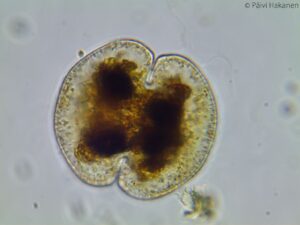
You can’t ignore Cosmarium perforatum if you meet it in your monitoring sample, it is that big. Skuja mentions in his “Vorarbeiten zu einer Algenflora von Lettland. IV” the size to be 60-70×54-63 μm, the thickness 34-39 μm. So it will make quite an impact on your biovolume. When the biovolume is counted using a flattened ellipsoid as the geometrical shape, following the “Guidance on the estimation of phytoplankton biovolume, The European Standard EN 16695” it would give 58 000 – 90 000 µm3 as a result.
What is further specific for this Cosmarium is that the cell wall doesn’t have any papillae or dots, unlike many of it’s close relatives. But it has some scattered pits all along the cell wall and in the middle there are some larger pits in the center of the semicells, so that it looks a bit perforated, thus the name.
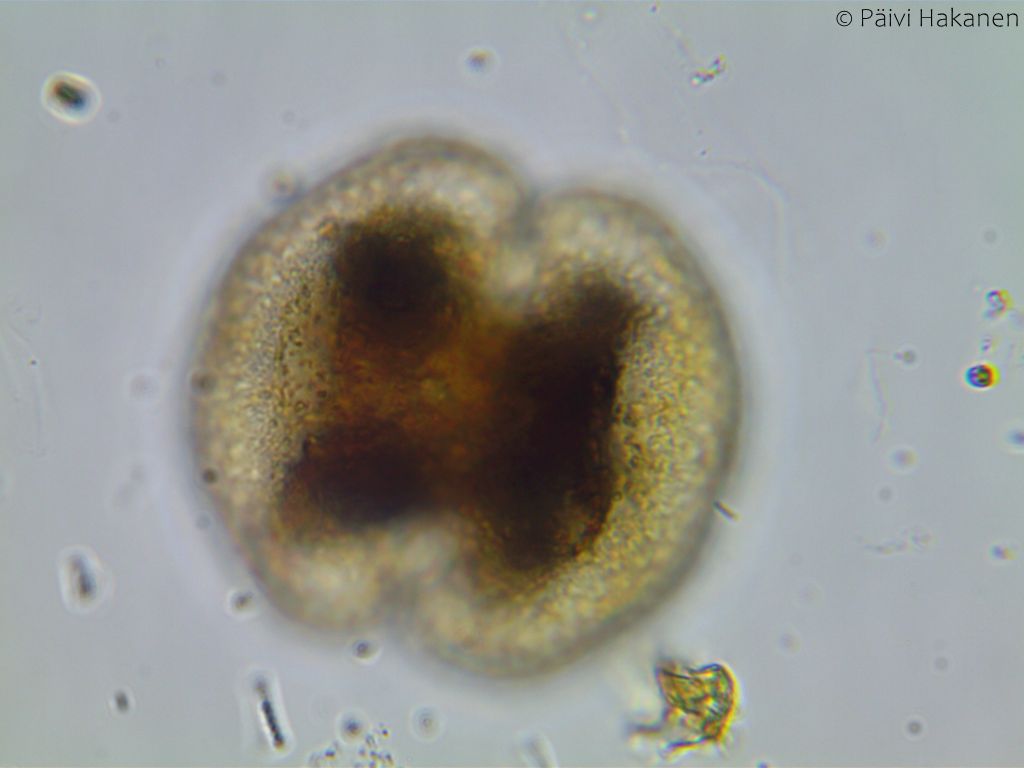
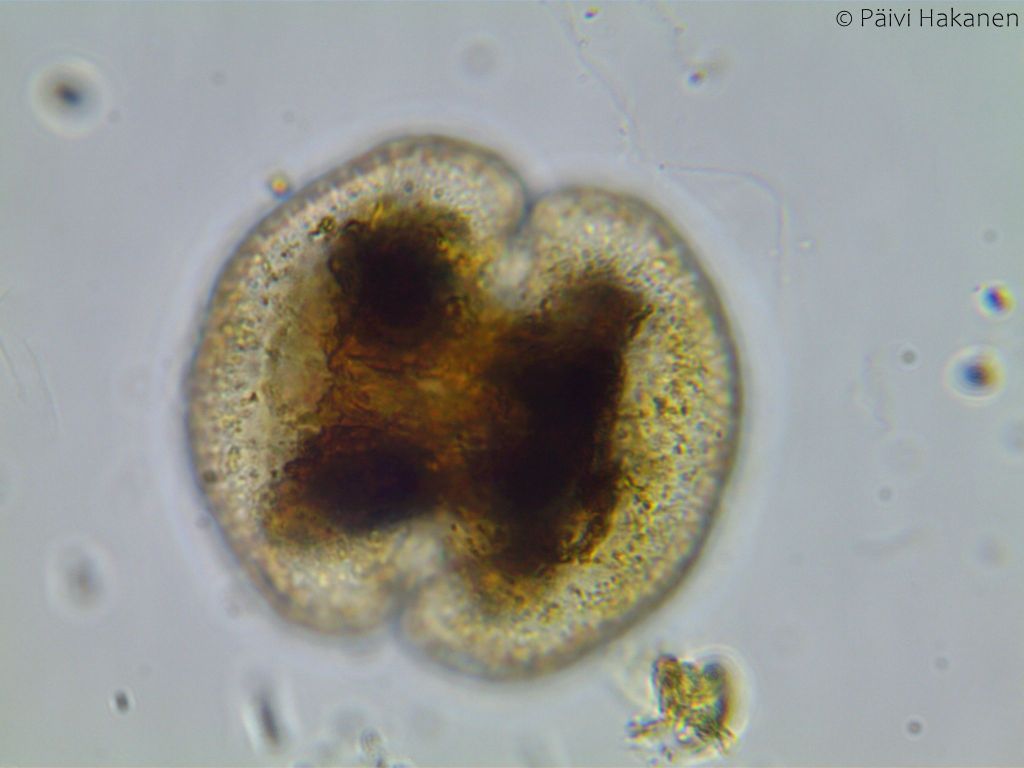
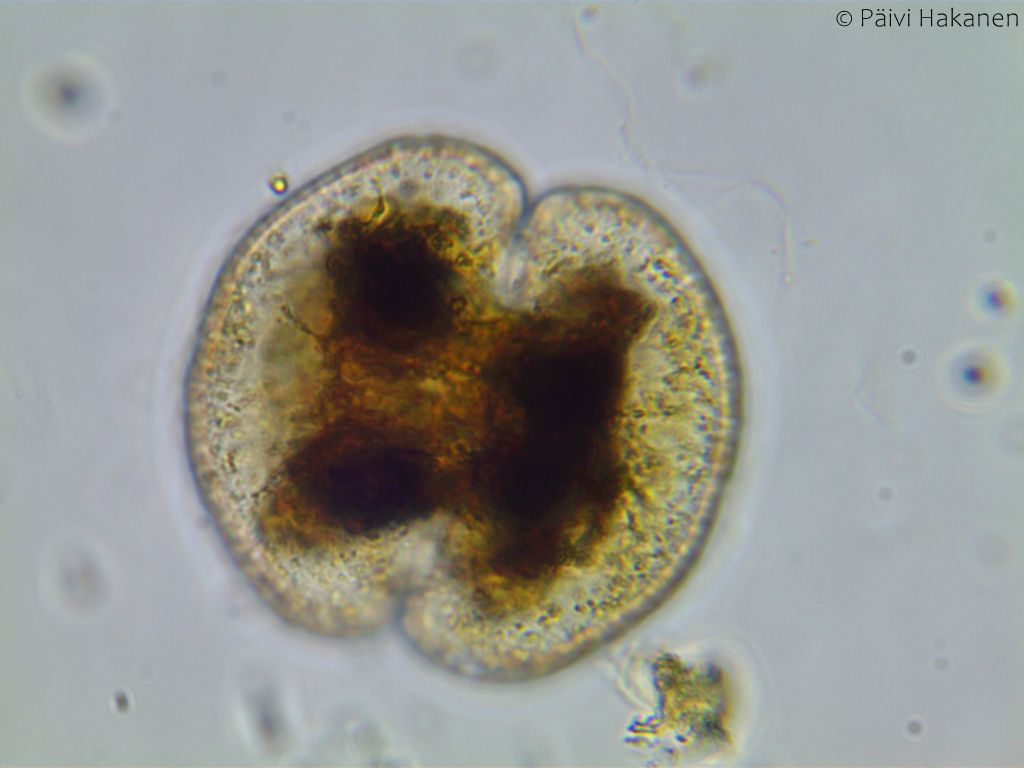
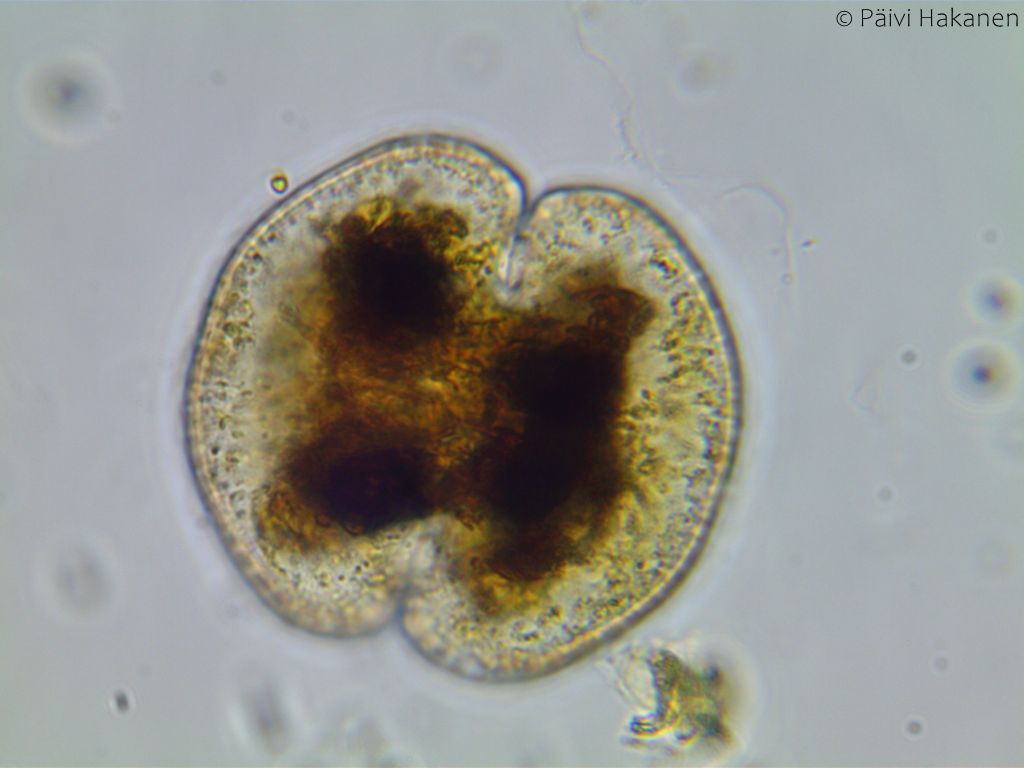
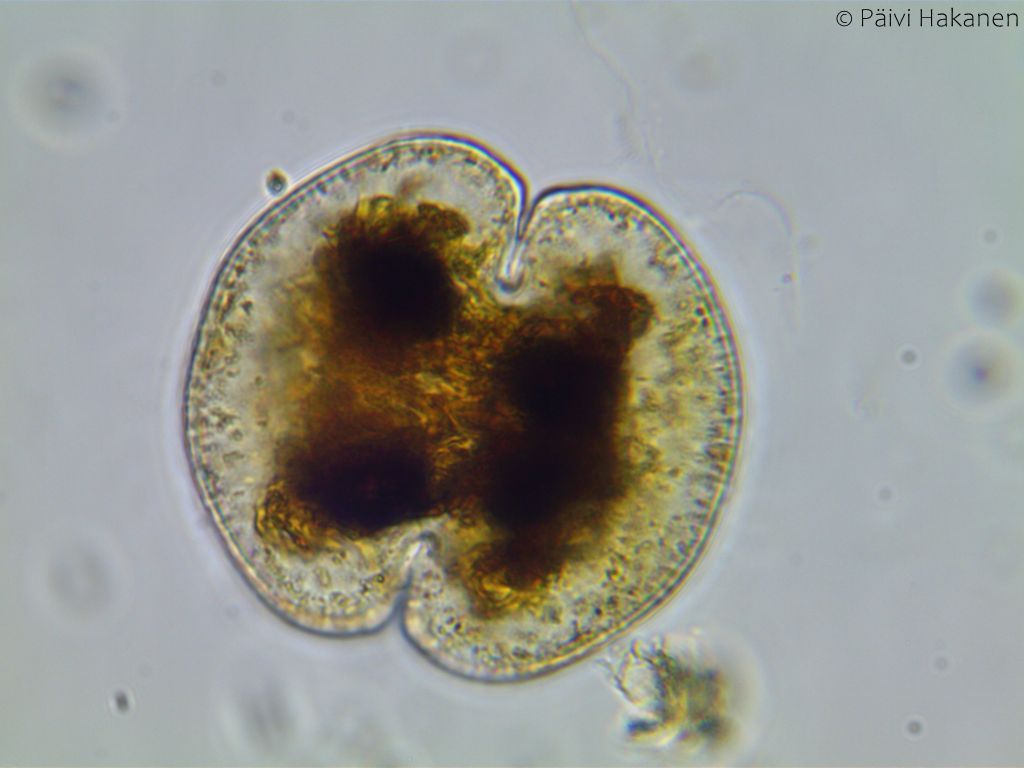
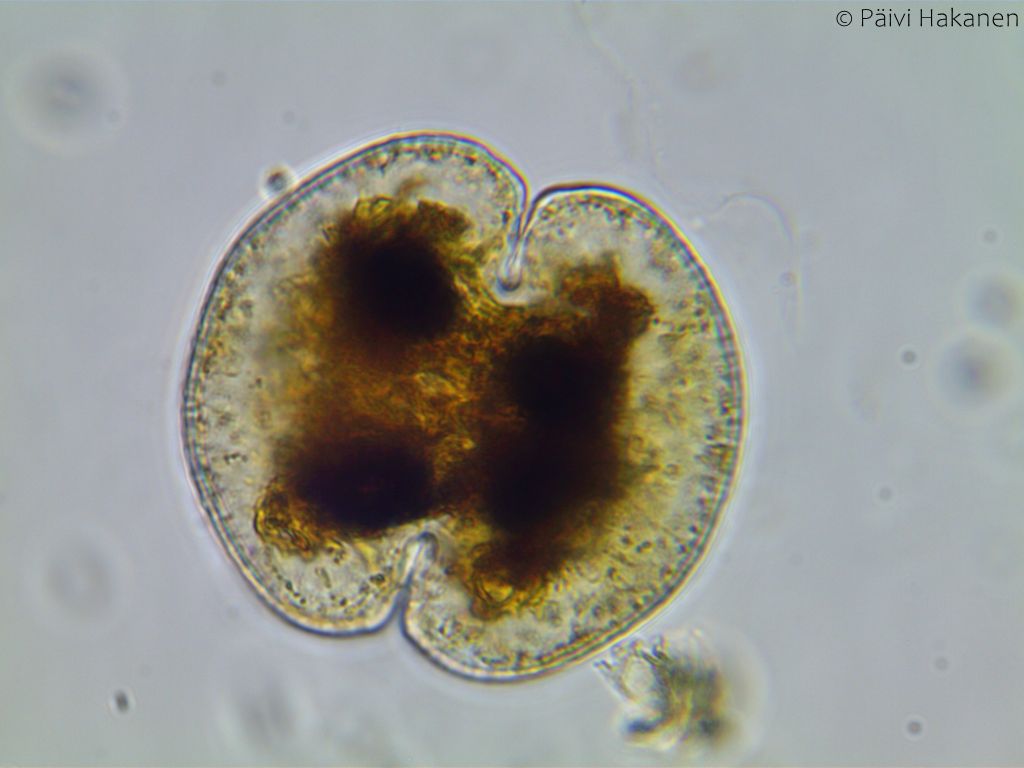
The middle part of the cell, the isthmus (= the bridge between the two cell halves) is very wide, about the half of the whole cell width. The cell halves almost touch each other, leaving the the gap between very small.
The shape of the cell half is typical: the upper part, apex, is flat(ish) while the sides go downwards first nice and easy, but after the middle they they turn back to the middle of the cell, giving the cell half a mushroom-like look. The outermost parts of the semicells, the basal angles, are a bit thickened, which is also specific feature for this big algae.
The differences
Ecology
Desmids.nl: In the Netherlands, C. perforatum is a very rare species, not encountered since more than half a century.
Literature and links
- Coesel, P.F.M. & Meesters, K.[J.] (2007). Desmids of the Lowlands Mesotaeniaceae and Desmidaceae of the European Lowlands. pp. [1]-351, 20 text-figs, 123 pls. Zeist: KNNV Publishing.
- https://www.desmids.nl/maand/english/cosmarium_perforatum.html