



The story of PVIK
The thing about dichotomous keys, as we all know, is that they always give us two alternatives to choose from:
- is the alga round or cylindrical?
- does it have spines or not?
- etc.
A dichotomous key – as the name suggests, for those of us who have mastered a little Greek – divides a group of species into two: di = two, and tomē = cutting. The method has been used with great success since the late 18th century, when the renowned French naturalist Jean-Baptiste Lamarck published Flora Française.
By answering the questions in the key, we gradually get closer to the solution, often right down to species or variety level. But if you make a wrong choice somewhere along the way, you have to go back and start again.
That is all perfectly fine, and you certainly learn a lot about the species along the way. But it can take some time. And time has become increasingly valuable.
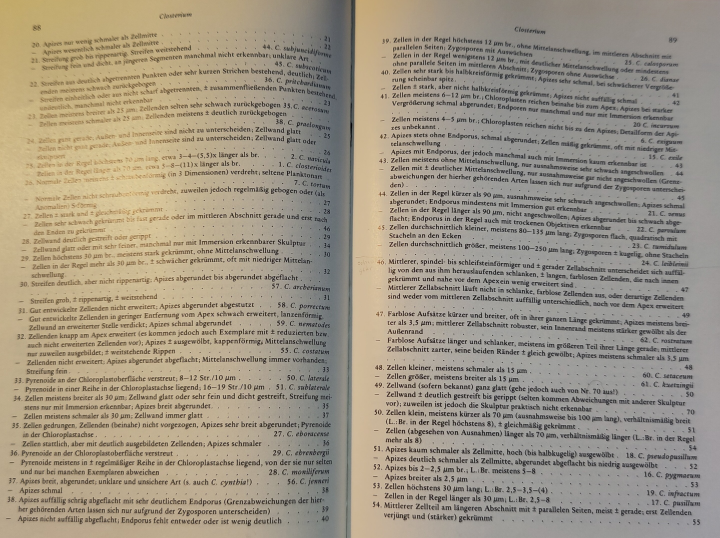
Picture of a part of Closterium key by Růžička , J. (1977). Die Desmidiaceen Mitteleuropas. Vol. 1(1) Stuttgart: E. Schweizerbart’sche Verlagsbuchhandlung.
So, how could we speed things up?
Where the idea came from
When I started my career in plankton identification in the late 1990s in the Netherlands, the company I worked for (Koeman en Bijkerk bv, nowadays part of Waardenburg Ecology) organised a workshop for colleagues on copepod identification.
Now, copepods are famously difficult to identify. The reliable differences between species are found in the fifth pair of legs – or P5, as copepod enthusiasts like to call them.
The problem is that this pair of legs is very small and located on the ventral side of the animal. So, you very rarely get a good look at it without taking more drastic measures: cutting the animal into pieces, turning the abdomen around, and counting the hairs and spines on the appendages – all under the microscope.
No wonder copepods are not the most popular plankton group to identify!
For the workshop, my task was to teach participants how to distinguish one freshwater copepod from another. I used P5, of course, but I also created some Excel spreadsheets (I love Excel!) and graphs that provided an overview of the whole group based on characteristics that were much easier to see.
These included features such as body length, the length of the antennules compared with thorax length, and the length of the furca. I had four such easy-to-observe characteristics.
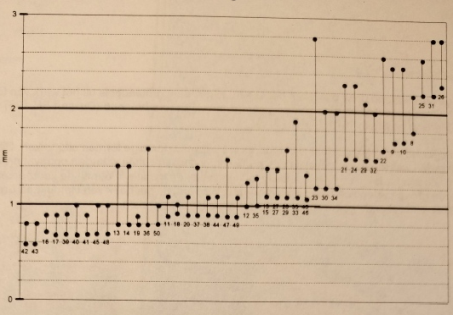
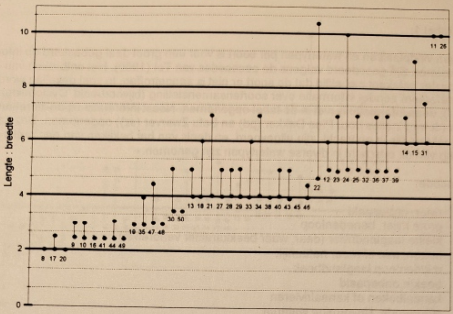
The first visual presentation of plankton features in graphic form – the length of the cycylopoids and ratio of furca length to width. The numbers refer to the 50 different cyclopoids.
The idea was simple: select a feature, look at the graph to see which species fall within the range you are dealing with, and write down the species names – or their numbers. Do this for all four characteristics, and you will probably end up with only a handful of candidates for which all the features match.
In other words, you can narrow down the candidates from 50 to perhaps one to four.
If all goes well…
The birth of PVIK
This was the starting point for PVIK.
The next step was to make the system interactive, so that features could be changed on the fly rather than being locked into static graphs. This was when I created a whole bunch of wonderful Excel files for different groups…
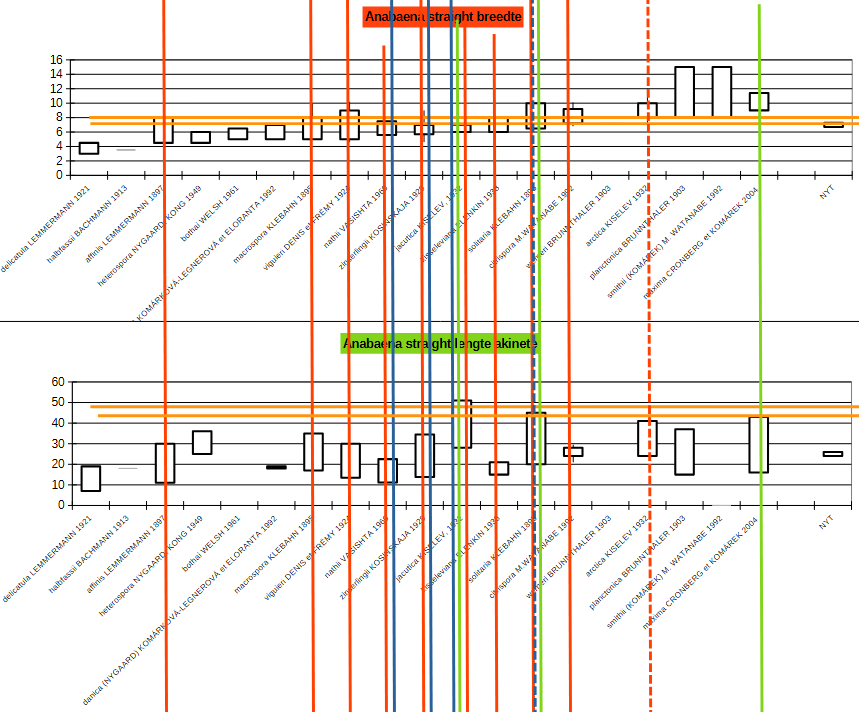
Nobody else seemed particularly keen to use them, but they worked for me!
I started thinking about how the idea could be automated. Unfortunately, I never got much further than the basics of programming, so I could not build it myself. Then there was the lack of time – and, of course, no money to pay a programmer to do the job.
So I continued working with my Excel files, hoping that one day I would be able to turn the idea into a proper computer programme.
That day finally came in 2025, when I received a little funding that allowed me to hire a programmer to develop an app that could be used while counting plankton samples. The programmer wizard is Dan Blackburn, a fellow Kemiö islander.
PVIK was born.
What does the future hold?
The plan is to continue developing the app and adding new groups. I am aiming to add at least 15 new groups per year. For now the app is kept very basic, with only the key itself in it. All the further information is written on the homepage. Later the app might include also information about the species, groups, background etc. There are also plans to add pictures and photos of the algae, but that has to wait till there is money and time for it.