



Aulacoseira
Subscription PVIK
Phylum: Bacillariophyta
Class: Coscinodiscophyceae
Order: Aulacoseirales
Family: Aulacoseiraceae
Genus: Aulacoseira
This key covers the Aulacoseira species commonly found in European waters. The features used in the key have been chosen because they are comonly used in literature and almost always visible: half-cell length (= Mantelhöhe), width, length-to-width ratio, length of the spines, the direction of the rows on the mantle valve, and how densely the rows are arranged.
Other useful features are mentioned in the additional information for each species. Chloroplasts can also be helpful for identification, as nicely described by Dr. Eileen Cox in her book Identification of Freshwater Diatoms from Live Material. Some of own observations are added to the additional information.
You sometimes hear that diatoms cannot be identified from Lugol-preserved samples. Well, that is not quite true. Many planktic diatoms have clear enough differences to be identified with “only” a light microscope, even in counting chambers. Of course, having good optics makes life of a phytoplankton identifier considerably easier.
23 taxa in PVIK:
Aulacoseira alpigena
Aulacoseira ambigua
Aulacoseira crassipunctata
Aulacoseira crenulata
Aulacoseira distans
Aulacoseira granulata
Aulacoseira granulata var. angustissima
Aulacoseira islandica
Aulacoseira italica
Aulacoseira italica var. tenuissima
Aulacoseira lacustris
Aulacoseira laevissima
Aulacoseira lirata
Aulacoseira muzzanensis
Aulacoseira nivalis
Aulacoseira perglabra
Aulacoseira pfaffiana
Aulacoseira pusilla
Aulacoseira subarctica
Aulacoseira subarctica f. recta
Aulacoseira tenella
Aulacoseira tethera
Aulacoseira valida
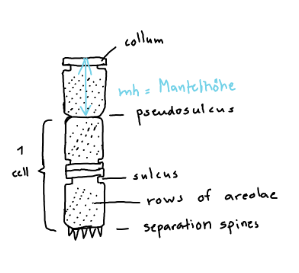
Aulacoseira frustule with features useful for identification.
Literature used for the key:
Cox, E.J., 1996. Identification of freshwater diatoms from live material. Chapman & Hall, 158 p.
Denys, L., Muylaert, K., Krammer, K., Joosten, T., Reid, M. & Rioual, P. (2003). Aulacoseira subborealis stat. nov. (Bacillariophyceae): a common but neglected plankton diatom. Nova Hedwigia 77(3/4): 407-427.
Houk, Vaclav 2003. Atlas of freshwater centric diatoms with a brief key and descriptions. Part 1. Melosiraceae, Orthoseiraceae, Paraliaceae and Aulacoseiraceae. Czech Phycology Supplement 1, 112 p.
Houk, Vaclav & Rolf Klee 2007. Atlas of freshwater centric diatoms with a brief key and descriptions. Part 2. Melosiraceae and Aulacoseiraceae. (Supplement to part 1) Fottea 7 (2) 85-255.
Houk, V., Klee, R. & Tanaka, H. (2017). Atlas of freshwater centric diatoms with a brief key and descriptions. Second emended edition of Part I and II. Melosiraceae, Liparogyraceae, Paraliaceae and Aulacoseiraceae. Fottea 17(Supplement): 1-616.
Krammer, K. & Lange-Bertalot, H. 1991. Bacillariophyceae. 3.Teil: Centrales, Fragilariaceae, Eunotiaceae. Julk.: Ettl, H., Gerloff, J., Heynig, H. & Mollenhauer, D. (toim.), Süsswasserflora von Mitteleuropa, Band 2. Stuttgart, Gustav Fischer Verlag, Jena. 576 p.
Nygaard, G. 1956. Ancient and Recent flora of diatoms and Chrysophyceae in Lake Gribsø. In: Kaj Berg and Ib Clemens Petersen (Eds.), Studies on the humic, acid Lake Gribsø. Folia Limnologica Scandinavica 8.
Round, F.E., Crawford, R.M. & Mann, D.G. 2007. The diatoms. Biology and morphology of the genera. pp. [i-ix], 1-747. Cambridge: Cambridge University Press.
Spaulding et al. 2021. Diatoms.org: supporting taxonomists, connecting communities. Diatom Research 36(4): 291-304. https://doi.org/10.1080/0269249X.2021.2006790
Tikkanen, Toini 1986. Kasviplanktonopas. Suomen Luonnonsuojeluliiton tuki Oy. Helsinki.
Tuji, A. 2015 Distribution and taxonomy of the Aulacoseira distans species complex found in Japanese harmonic artificial reservoirs Bull. Natl. Mus. Nat. Sci., Ser. B 41(2): 53–60.
Tuji, A. & Houki, A. 2004. Taxonomy, ultrastructure and biogeography of the Aulacoseira subarctica species complex. Bulletin of the National Science Museum, Tokyo, Series B, Botany 30(2): 35-54.